The Smartgun FX Module: One Platform, Two Weapons
The M56 Smartgun was the second Replicant FX electronics module — built on the same PIC microcontroller platform as the Pulse Rifle but with a completely different sound character and firing behavior. A look at the hardware, firmware, and sound design.
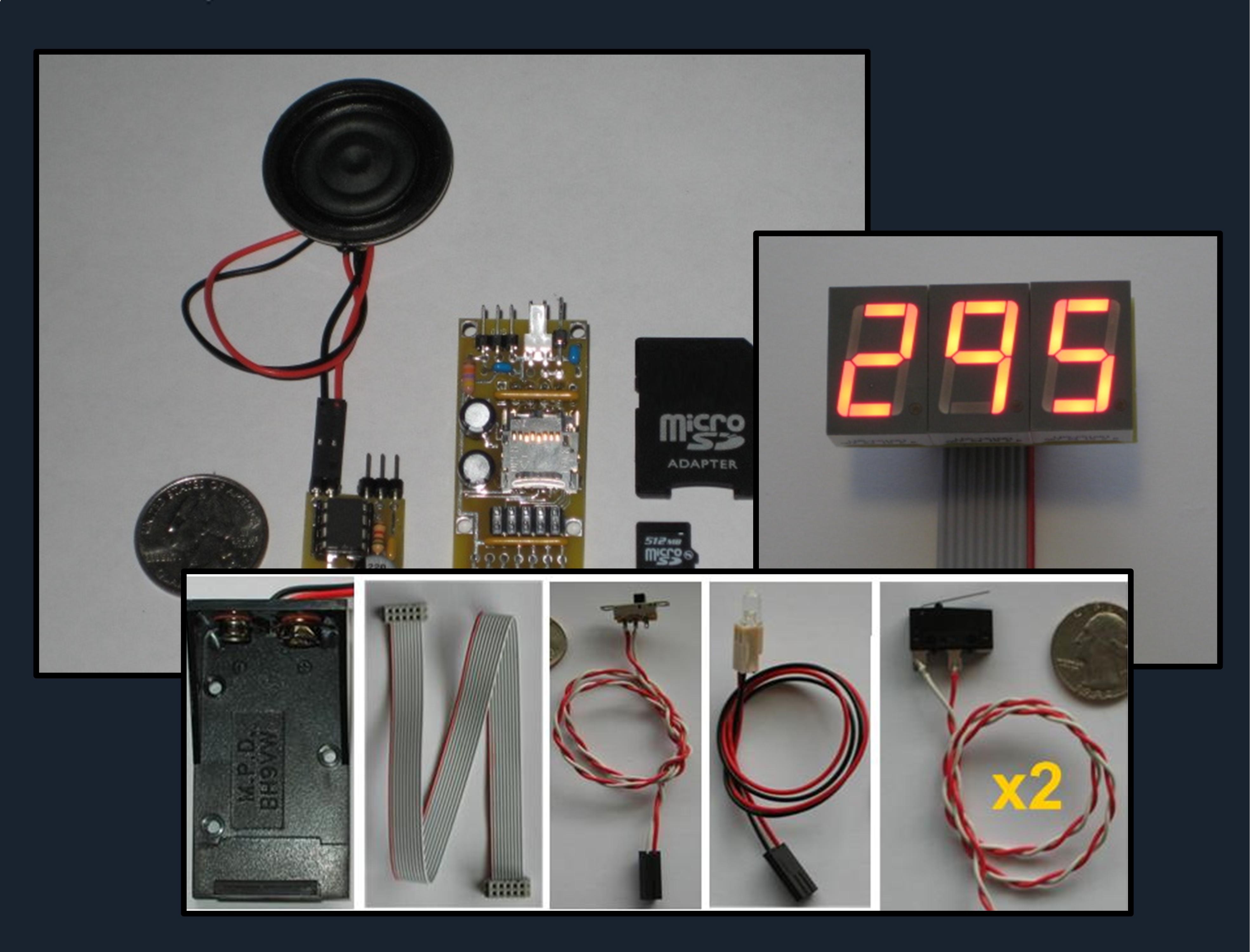
The Other Gun
The M41A Pulse Rifle gets most of the attention in the Aliens prop community. It has the famous ammo counter. It has the distinctive three-shot burst sound. It has decades of community build documentation behind it.
But it is not the only weapon in the film that prop builders want to replicate. The M56 Smartgun — the crew-served machine gun carried by Vasquez and Drake, mounted on a steadicam-style harness, with its distinctive spinning barrel and continuous fire — is its own category of prop challenge. And it has its own sonic signature: a heavy, mechanical spin-up followed by sustained automatic fire.
The Smartgun FX Module was the second product in the Replicant FX line. Same underlying microcontroller platform. Completely different personality.
The Sound Problem
The pulse rifle fires in short bursts. The sound design problem there is randomization — three or four distinct shot variants, selected pseudo-randomly, synchronized to a trigger pull that lasts a fraction of a second. The challenge is avoiding repetition in what is fundamentally a short, repeating event.
The Smartgun fires continuously. The sound design problem is different: you need a spin-up sequence, a sustained loop that does not audibly repeat, and a spin-down. The listener is not hearing discrete events — they are hearing a continuous mechanical process that changes state. Cut it wrong and it sounds like a looping MP3. Do it right and it sounds like a real machine.
The firmware handled this with a four-sound architecture, documented in SG_Sounds.txt:
| Sound | Start (bytes) | Description |
|---|---|---|
| Shot1 | 0 | Primary shot variant |
| Shot2 | 9,990 | Secondary shot variant |
| Shot3 | 14,985 | Tertiary shot variant |
| Shot Loop | 15,635 | Sustained fire loop |
The shot variants handled the initial burst. The Shot Loop was the continuous fire sound that played while the trigger was held. Transitioning cleanly between the initial shots and the loop — hitting the loop at a point where it didn’t produce an audible stitch — was the critical audio engineering problem.
The WAV source library reflects how many iterations this took:
- Shot1.wav, Shot2.wav, Shot3.wav — primary effects
- Shot_Loop.wav — the sustain loop
- Shot_Rework.wav, Shot_Rework2.wav — revised versions
- SG_Sample_3.wav — a later sample attempt
- wil_smart_ready.wav — a small startup/ready sound effect
Multiple rework passes are documented in the archive, dated across February and November of 2008, with at least four distinct rework sessions (Rework 04Feb08, Rework 20 Nov, Rework 21 Nov, Rework 26Feb08). The loop point was the thing that kept getting revised.
The Firmware
The Smartgun module ran on a PIC18F2520 — the same chip family as the later Halo AR and pulse rifle variants. The firmware (Main2.c, Main3.c, compiled to SG1.hex) used the same interrupt-driven audio architecture: 8-bit unsigned PCM stored as a ROM array, played back through PWM output at 10kHz, with a timer interrupt advancing the sample pointer at each tick.
The sound map (Sounds[] array) held byte offsets into the main Sound_File[] array, allowing the firmware to jump to any sound by index. The sustained fire loop required the firmware to jump back to the loop start point on completion rather than advancing to the next sound — a special-case behavior that the trigger-held state managed.
The MPLAB project file (SG1.mcp) and compiled firmware (SG1.hex) are both intact in the archive, along with the Visio-format data sheet (SG_Data_Sheet.vsd) documenting the module’s pinout and electrical interface.
One PCB, Different Behavior
The Smartgun module had its own PCB (Smartgun.pcb), distinct from the pulse rifle board layouts. The physical constraints were different — the Smartgun prop harness is a larger, more complex build than the pulse rifle, with different cable routing and mounting considerations.
But the schematic topology was recognizably the same platform: PIC18F, PWM audio output, digital inputs for trigger state, LED outputs for any light effects. The differences were in the firmware and the sound library, not the fundamental hardware design.
This was the point of building on a platform rather than designing new hardware per product. The pulse rifle board and the Smartgun board shared a common architecture, common development toolchain (MPLAB IDE), and common audio encoding approach. Adding a new weapon variant meant new sounds and new firmware behavior, not a hardware redesign.
What the Demonstration Tracks Show
The archive includes two full demonstration WAV files — Sound_Demo_1.wav (908KB) and Sound_Demo_2.wav (999KB) — which appear to be complete audio demonstrations of the module’s behavior, likely created to show customers what the assembled system sounded like before purchase.
At 10kHz, 8-bit mono, 908KB is roughly 90 seconds of audio. That is a long demonstration — long enough to cycle through the spin-up, sustained fire, and spin-down sequences several times, probably with some variation in trigger hold duration to show the loop’s behavior.
There is also wil_smart_ready.wav — 13KB, which at 10kHz is about 1.3 seconds — a short startup or ready tone. The name suggests it was contributed or sourced from a specific community member (“wil”), which tracks with how the prop community operated at the time: shared resources, credited by handle.
Part of a Larger System
The Replicant FX product line was never just the pulse rifle. The About page stated the mission explicitly: replicas and props should not be built only to be looked at, but experienced to their full vision. The Smartgun was the second proof of that — a completely different sonic and behavioral problem, solved with the same underlying platform.
The hardware architecture that made the pulse rifle work — PIC microcontroller, ROM-embedded PCM audio, PWM playback, trigger-synchronized LEDs — translated to the Smartgun with firmware changes and a new sound library. That is what a real platform gives you: the ability to solve new problems without starting over.
The pulse rifle had twenty firmware releases. The Smartgun had four documented rework sessions before its firmware was finalized. Both products shipped. Both worked. And both traced back to the same question: what would it take to make a prop actually feel like the thing it is supposed to be?
This article is part of a series on the Replicant FX electronics modules. See also: The Pulse Rifle FX Module and Designing Sci-Fi Sound from Scratch: Inside the Pulse Rifle Audio Engine.