Designing Sci-Fi Sound from Scratch: Inside the Pulse Rifle Audio Engine
How do you fit convincing gunfire audio inside a PIC microcontroller with a few kilobytes of ROM? A deep look at the embedded audio architecture behind the Pulse Rifle FX Module — from raw PCM arrays to randomized playback.
The Problem with Sound in Props
Getting a prop to make noise sounds easy until you try to do it properly. A small speaker module with a pre-recorded loop will technically produce audio. But it sounds like a toy — because it is a toy. Every trigger pull plays the same sound in the same sequence, at the same volume, with the same artifacts. After two pulls, the illusion is gone.
The M41A Pulse Rifle from Aliens has a very specific sonic signature that the community has obsessed over for decades. Three distinct shot sounds. A hollow metallic click for an empty chamber. A different tonal character for the grenade launcher. These all need to be randomized, timed correctly, and synchronized with physical events — a real trigger microswitch, a real removable magazine.
The PR Original module had to do all of this inside a PIC microcontroller with ROM measured in kilobytes.
How Audio Lives in a Microcontroller
On a microcontroller with no external storage, there are two options for audio: generate it synthetically (tones, waveforms) or store digitized samples directly in flash ROM.
The PR Original used the second approach — raw 8-bit PCM stored as a C array compiled directly into firmware:
static rom unsigned char rom Sound_File[] = { 127, 131, 135, 142, 148, 153, 158, 162, 165, 167, ...};Each value is an unsigned byte, 0–255. Silence is 127 — the center point of the range. Louder peaks push toward 0 or 255. The microcontroller reads these values from ROM and pushes them through a PWM (Pulse Width Modulation) output pin, which a low-pass filter converts into an analog audio signal. The timer interrupt fires at the sample rate — typically 10kHz — and advances the pointer through the array one byte at a time.
That 10kHz sample rate is the floor for anything resembling real audio. Compare to CD quality at 44.1kHz or telephone at 8kHz. At 10kHz you can produce recognizable gunfire and clicks. You cannot produce music. But for a prop — where the speaker is small, the acoustic environment is noisy, and the listener is moving — 10kHz is enough.
The Sound Map
To manage multiple sounds within a single flat ROM array, the firmware used an offset table alongside the data:
static rom unsigned int rom Sounds[] = {0, 3320, 6022, 9032, 9682};Each entry is the starting byte index of a sound effect within Sound_File[]. The length of each sound is the difference between consecutive entries:
| Sound | Start | End | Length (bytes) |
|---|---|---|---|
| Shot1 | 0 | 3320 | 3,320 |
| Shot2 | 3321 | 6022 | 2,701 |
| Shot3 | 6023 | 9032 | 3,009 |
| Empty | 9033 | 9682 | 649 |
The firmware selects a sound by loading its start offset into a pointer, setting the end boundary from the next entry, and letting the timer interrupt walk the pointer to completion.
The empty-chamber click is notably short — 649 bytes, versus roughly 3,000 for a shot. That matches the physics: a mechanical click has a fast transient and decays quickly. A gunshot has an initial crack followed by a longer pressure wave. Allocating the right byte budget to each sound was as much about ear-testing as it was math.
Randomization Without a Random Number Generator
A microcontroller running deterministic firmware has no true randomness. If you play Shot1, Shot2, Shot3 in sequence, it loops and the pattern becomes obvious immediately.
The Halo AR variant (which used the same audio architecture as the pulse rifle) solved this with a pre-computed lookup table:
static rom unsigned char rom SND[] = { 0,1,2,0,2,0,0,1,2,2,0,2,0,1,2,1,1,2,0,1, 1,2,2,0,2,0,0,1,1,0,2,2,1,0,1,3,0,2,1,0};This 40-element array is a hand-shuffled sequence of sound indices. The firmware walks through it with a pointer that advances on each trigger pull. At index 40 it wraps back to 0. The result sounds random because the pattern is long enough that the listener never consciously identifies the cycle — especially with the sound effects themselves varying in duration.
Index 3 appears once in that sequence — the empty-chamber click. Which means approximately 1-in-40 pulls would unexpectedly trigger the click sound even with a loaded magazine. That was a quirk of the lookup design, not intentional, and it got cleaned up in later firmware revisions.
Four Generations of Sound Design
The sound data went through four major revision cycles, tracked separately from the firmware itself. Each version is a different set of C arrays — the raw PCM samples — reflecting updated field recordings or processing decisions.
Version 1 (PIC_SND.txt): Four sounds — Shot1, Shot2, Shot3, Empty. Tight ROM budget. This was the baseline.
Version 2 (Combine_Sound.txt): Expanded to seven sounds. The offset table grew:
static rom unsigned int rom Sounds[] = {0, 3320, 6022, 9032, 10073, 14013, 26510};The jump from 9682 bytes (V1 total) to 26510 bytes indicates a significant expansion of the sound palette — likely adding cocking and grenade sounds to the ROM set, or adding longer, higher-quality shot variants.
Version 3 (Ver3_SNDS.txt): Eight sounds. Further refinement:
static rom unsigned int rom Sounds[] = {0, 3320, 6022, 9032, 9654, 13582, 28334, 28796};The 28796-byte total is approaching the upper limit of what a mid-range PIC can hold in program flash. At this density, fitting the sound data plus the actual firmware code became a careful packing exercise.
Version 4 (PIC_SND_4.txt): Custom addressing scheme with explicit byte-range labels:
SND1: 0 - 3000 "Shot1"SND2: 3000 "Shot2"SND3: 4500 "Shot3"SND4: 7500 "Empty"The Ver4_Cocking variant added mechanical sounds for the pump-action grenade launcher, with deliberate null (zero/silence) blocks between samples to prevent audio bleed between adjacent sounds.
The FX Module: Moving Audio Off-Chip
The PR Original’s ROM-based architecture was elegant but inflexible. Once flashed, the sounds were immutable. If a customer had a specific WAV file they wanted — a higher-quality recording, a different tonal character, sounds from a specific film cut — there was nothing to be done.
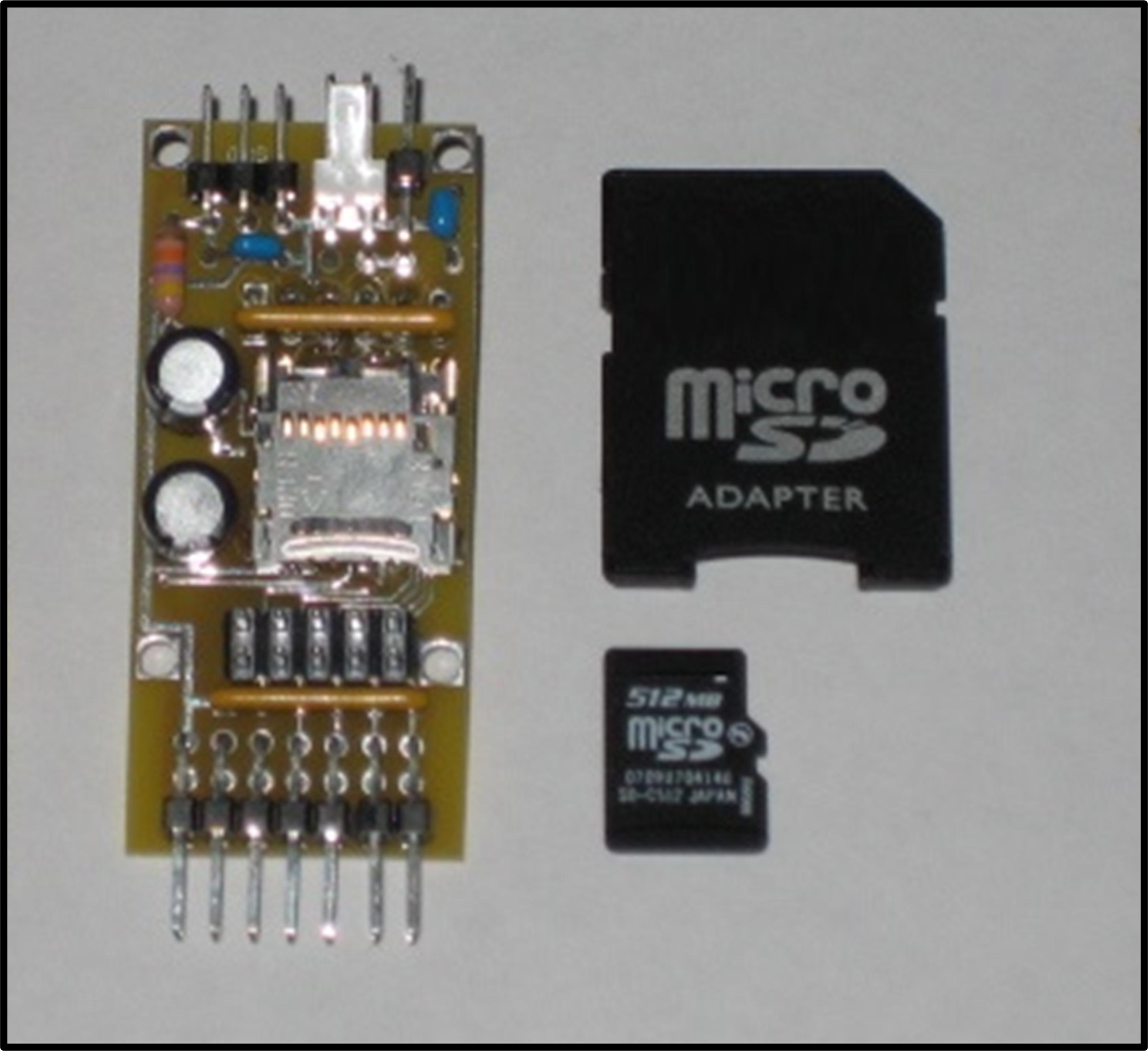
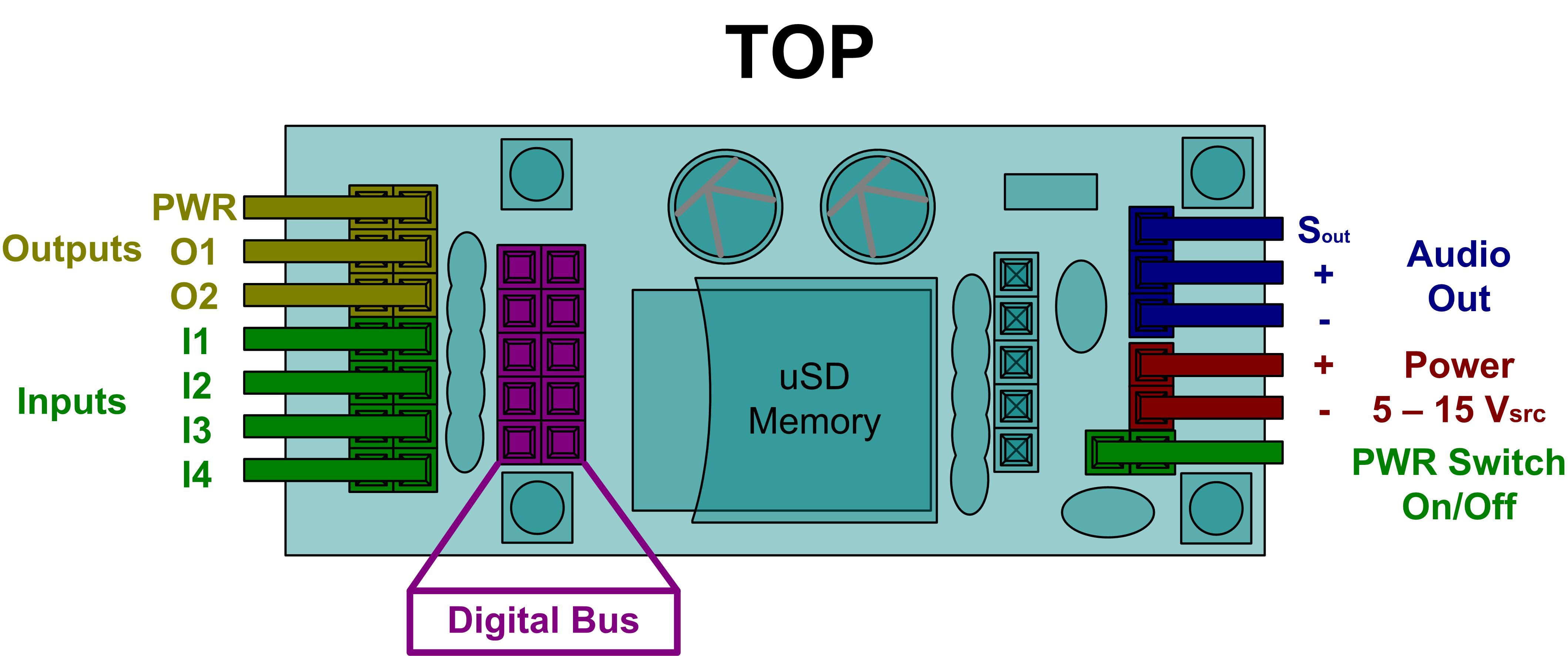
The FX Module solved this by moving audio entirely to an SD card. Standard WAV files. User-replaceable. Up to 2GB.
This shifted the audio engineering problem. Instead of compressing audio into microcontroller ROM, the firmware now had to manage a FAT filesystem, buffer audio from a card with variable read latency, and maintain synchronization with the light outputs while doing so. The onboard 1-watt amplifier replaced whatever the customer had been connecting externally.
The configuration shifted to a simple text file on the card — MODULE.txt — that mapped function (power-up sound, shot sounds, grenade sounds, radio clips) to numbered WAV files. Customers could edit this file with any text editor and drop their own recordings into numbered slots.
Why This Mattered
The prop community had always been able to build things that looked right. What was missing was electronics that made them feel right — that responded to the same physical inputs as the real prop and produced the same sensory output.
The audio engineering on the PR Original was constrained in ways that modern audio hardware makes unthinkable. 10kHz sample rate. 8-bit depth. A few thousand bytes of ROM. Pre-computed randomization tables. Offset arithmetic instead of file systems.
But working within those constraints produced something that worked — that fit inside a resin casting, ran on a 9V battery, and reliably produced three distinct shot sounds in a non-repeating sequence with a synchronized muzzle flash, every time someone pulled the trigger.
That was the goal. The constraints were just the engineering problem in between.
This article is part of a series on the Replicant FX pulse rifle electronics system. See also: The Pulse Rifle FX Module: Building a Commercial Prop Electronics Product and the Halo AR build log for a prop that used the same audio architecture.